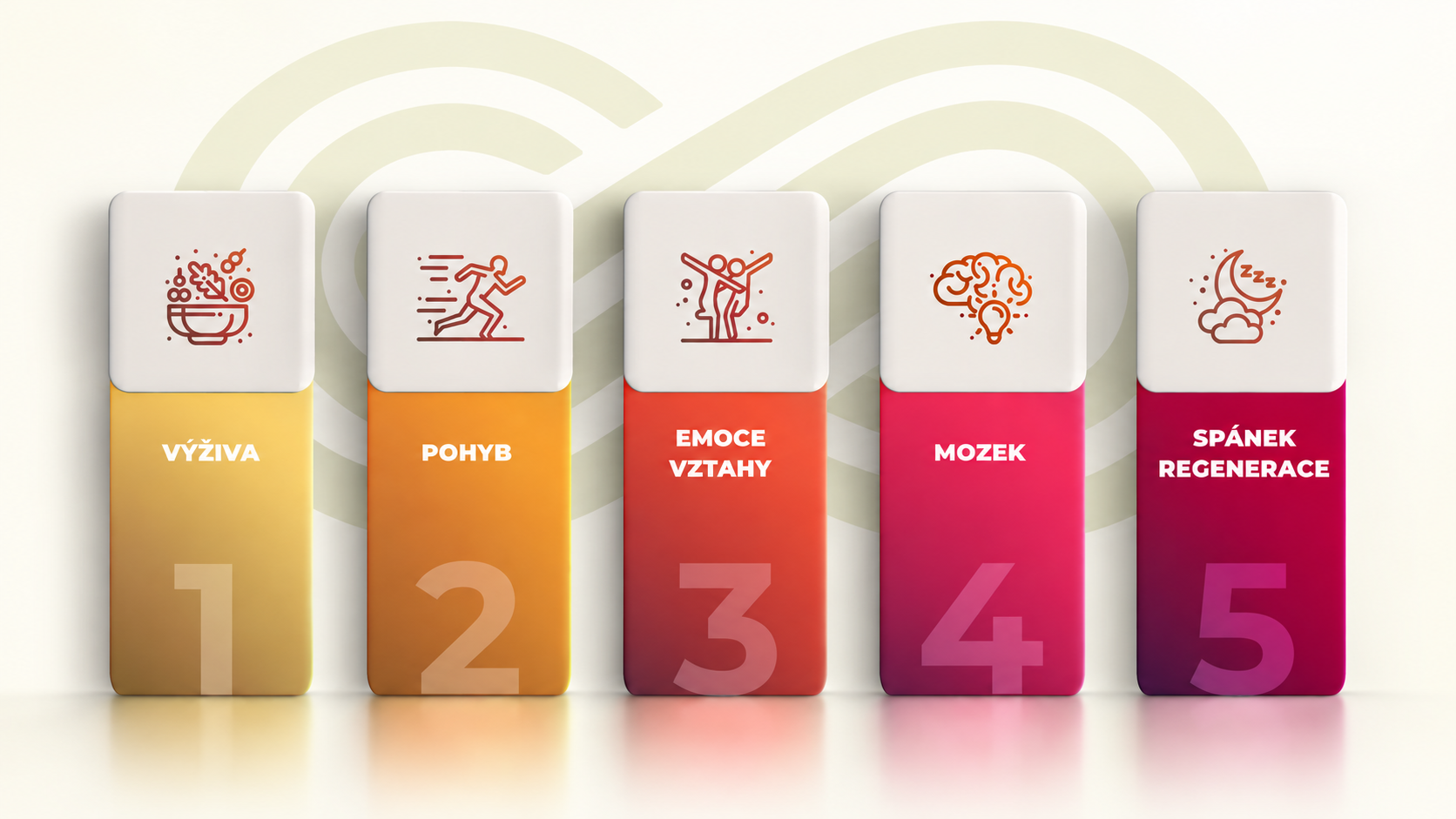
5 Pillars of Longevitality
Eating, moving, thinking, loving someone, and getting a proper night's sleep. At first glance, nothing one would expect a Nobel Prize for. Yet these five ordinary foundations determine the quality, healthspan, and energy of our future decades. We call them the five pillars of longevitality.
Unfortunately, human beings do not come with an instruction manual. Which is rather peculiar. Buy an electric kettle, and you receive sixteen pages of instructions in seven languages, even though it only has a single button. For an organism built of trillions of cells designed to function for eighty, ninety, or a hundred years, you get zero guidance.
So we improvise. A few tips from parents, some advice from a doctor, pointers from a gym buddy, and the rest from the internet. The internet, by the way, can simultaneously recommend eating breakfast, skipping breakfast, eating six meals a day, eating once a day, cutting all carbs, and drastically increasing dietary fiber—all in a single afternoon.
No wonder people get overwhelmed. But when you step back and look at human biology, you realize that what truly works is neither brand-new nor complicated. In fact, it rests upon five essential pillars:
Nutrition – Movement – Emotions & Relationships – Brain – Sleep & Regeneration.
None of them plays a solo act. They operate like a five-piece band. Each plays a distinct instrument, but if just one member falls out of rhythm, the entire song suffers. Let's look at what each instrument does.
NUTRITION
For a long time, we viewed food very simply: eat something, gain calories, and keep going. But our body reads food far more meticulously than a restaurant menu.
Nutrients act as vital biochemical signals. Based on their quantity, composition, and timing, the organism continuously determines what it can afford to do. Is energy abundant? Can it grow and build? Or is it time to clean, repair, and conserve?
Problems arise when the body receives a non-stop message: Don't worry, food is everywhere. And more is coming in two hours. Chronic energy surplus and poor dietary habits drive insulin resistance, metabolic dysfunction, systemic inflammation, and accelerated biological wear.
For longevitality, metabolic flexibility is essential—the ability of the body to switch seamlessly between fuel sources and adapt to fed and fasted states.
We don't need exotic berries harvested under a full moon. What truly benefits the body is a diverse diet based on wholesome, minimally processed foods, ample quality protein and fiber, balanced fats and carbohydrates, and appropriate caloric intake.
In short: eat to provide everything your body needs, not just everything you crave.
MOVEMENT
The human body possesses a distinct principle: it maintains what you regularly use. Physical activity is not a punishment for yesterday's dessert. It is one of the most potent biological signals you can send: I still need you. Stay functional.
When we move, we don't just burn calories. Muscle contractions trigger a biological cascade. Vascular health improves, glucose uptake enhances, mitochondrial function surges, and muscles release specialized signaling molecules—myokines—that communicate with the entire body.
Muscle is not merely a tool to lift weights from point A to point B. It is an active metabolic organ and our greatest longevity reserve as we age.
With age, we naturally tend to lose muscle mass and strength. This affects metabolic health, joint stability, mobility, and long-term autonomy. Therefore, we need both endurance and strength.
You don't have to win a marathon. Your body doesn't demand medals. It simply asks for consistent, purposeful use.
EMOTIONS & RELATIONSHIPS
A human being is not a houseplant. You can eat organic broccoli, abstain from alcohol, speak five languages, do squats, and go to bed at 9:20 PM. And yet something fundamental might still be missing: meaningful human connection.
Homo sapiens is biologically a social species. Relationships are not a decorative accessory to a healthy lifestyle. Social connection, safety, intimacy, and meaningful bonds directly regulate psychological and physical health. Chronic loneliness and chronic stress distort cortisol rhythm, sleep, immunity, and inflammatory pathways.
That is why longevitality often benefits from things that don't fit into medical charts: dinner with dear friends, a warm hug, a deep conversation with phones tucked away.
Or a friend you can call at 2:00 AM knowing they will pick up—even if they tease you the next morning.
We sometimes obsess over what to put in our bodies, and forget to think about whom we let into our lives. Longevitality requires both.
THE BRAIN
The executive leader who must stay sharp in every meeting. Weighing roughly 1.5 kilograms, the brain orchestrates almost the entire enterprise: stress, sleep, hormones, movement, appetite, decision-making, emotions—and that mysterious reflex to open the fridge and forget why you walked into the kitchen.
For longevitality, the brain is vital not just so we remember where our keys are, but because it is the central adaptive regulator. It reshapes itself according to how we challenge it: Use it or lose it.
We need to explore new concepts. Read deeply. Debate. Create. Break routine. Try skills we aren't good at. The brain needs moments where it realizes: "I don't know this yet," and begins rewiring.
Neuroplasticity and curiosity keep cognitive vitality alive. Curious people almost invariably stay biologically younger.
SLEEP & REGENERATION
While you sleep, maintenance works the night shift. Sleep looks deceptively unproductive. You lie motionless, close your eyes, ignore emails, make no money, and do no exercise. Yet the body is performing its most crucial work.
During sleep, the brain consolidates memories, hormone levels recalibrate, immunity coordinates, and metabolic waste clearance accelerates.
Sleep is not an absence of function; it is a service mode. Just as with a car, ignoring scheduled maintenance because no warning light has turned red yet is a dangerous gamble.
Chronic sleep debt impairs glucose regulation, alters hormones, fuels stress reactions, and diminishes cognitive performance.
Regeneration also means alternating between strain and rest, activity and tranquility, light and dark. The body cannot constantly run on full throttle. Sometimes it needs the sophisticated command: Do nothing right now. And that is often the most productive decision you can make.
FIVE PILLARS. ONE LIFE.
Nutrition. Movement. Emotions & Relationships. Brain. Sleep & Regeneration.
Five fundamental pillars. None of them is magical on its own, but their synergy creates unstoppable vitality.
When we move, we sleep better. When we sleep well, we make wiser decisions. When we have strong relationships, we manage stress effortlessly. When we nourish ourselves, we have the energy to move. And when our brain thrives, we feel inspired to repeat these healthy choices tomorrow.
And in ten years.
Longevitality is not a race to live the longest. It is the journey to live every single day with vigor and fulfillment.