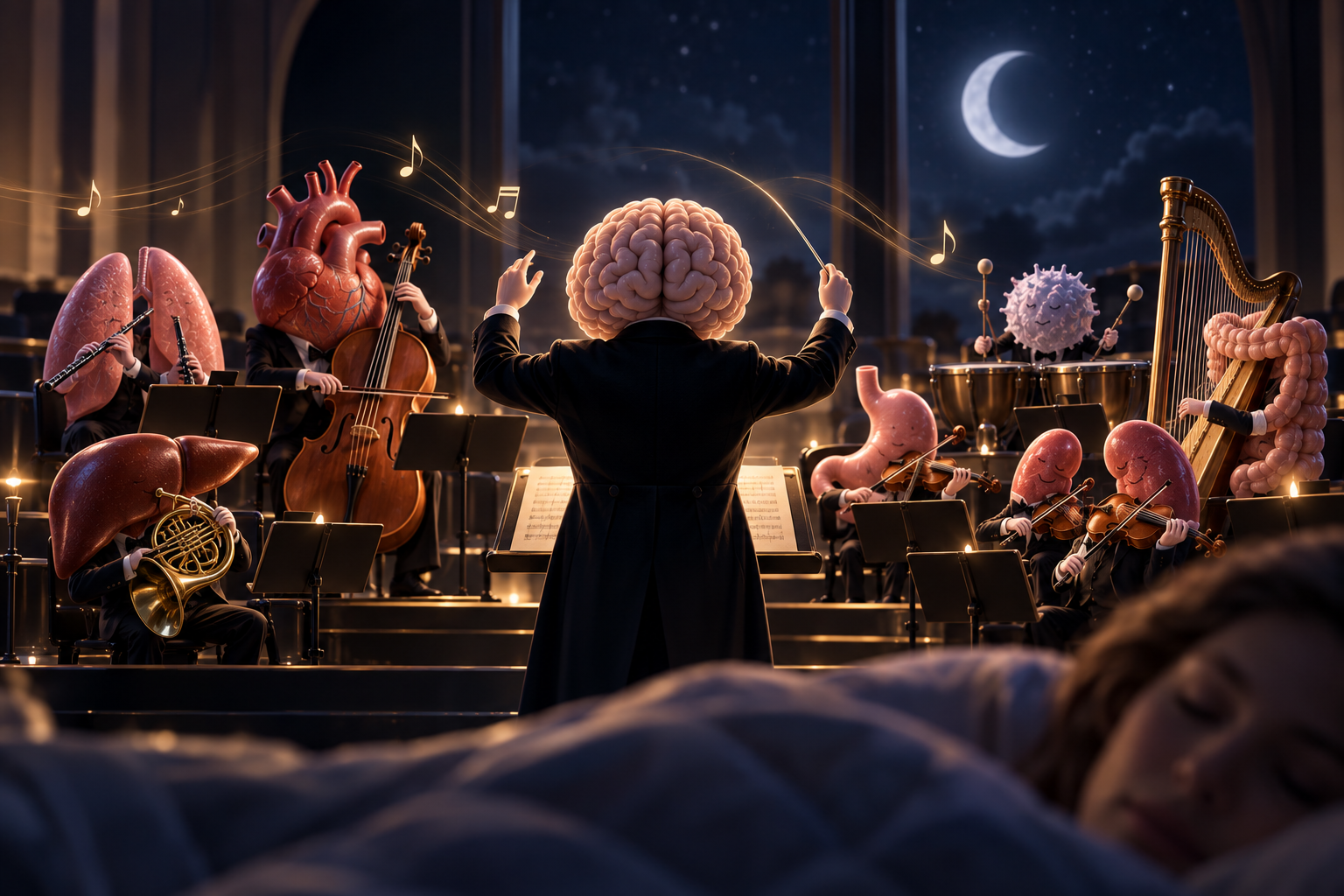
What Happens at Night in Your Bedroom
Evening arrives. We close the bedroom door, drop our clothes, and switch our phone to "Do Not Disturb". We draw the curtains, turn down the bed, and get to business.
It is time for one of the most remarkable events of the day: Sleep.
Excuse me? Sleep? Yes, you read that right. Extraordinary things happen during sleep! Sleep is anything but boring. Not by a long shot.
As soon as you close your eyes, a magnificent nighttime show begins. While you lie in bed doing "absolutely nothing", your organism shifts into a completely different operating mode.
The brain sorts information and consolidates memories. The hormonal landscape transforms. The immune system recalibrates its defense activity. Cells repair daytime wear and tear. And metabolism transitions into a slower, deeply restorative rhythm.
Time for Cleaning and Maintenance
Think of it like a factory running at peak production during the day. Lights blazing, machines humming, raw materials constantly moving to meet the daily quota. But intense production also causes wear and tear. Parts grind down. Filters clog. Things need repair, inspection, or recycling. Dust and debris accumulate.
And that is precisely how the human body works. Night is not merely a darker version of daytime. It is time for the cleaning crew. And they do not stop all night long.
The Biological Conductor and Organ Clocks
You may have heard of the "organ clock". Every organ in our body operates on its own circadian timeline. The liver, muscles, adipose tissue, pancreas, and gut behave differently across a 24-hour cycle. Gene expression, enzyme secretion, hormone sensitivity, and energy partitioning all fluctuate systematically.
Overseeing it all is the brain. The brain never truly sleeps. It acts as a biological conductor, constantly tuning the entire orchestra to stay in sync with the alternating cycles of light and darkness.
That is why what we do and when we do it matters profoundly. A heavy meal at 2:00 AM does not impact metabolism the same way as that exact meal at noon. That is like expecting a delicate romantic flute solo and having blasting saxophones interrupt the melody!
Likewise, intense blue light before bedtime is not just "a little extra light". And habitual night-owl behavior is not just "going to bed late". It changes the sheet music of the entire symphony.
You can get away with it for a while. But it won't produce a Mozart masterpiece.
Master of the Night Archives: The Glymphatic System
The brain is not just a conductor; it is also the chief archivist. At night, our glymphatic system activates. Think of it as a specialized information sorting, archiving, and shredding facility. During the day, we absorb an absurd volume of stimuli: faces, conversations, work tasks, aromas, card PINs. All of this must be processed, filtered, and cleared at night.
To make this internal organ symphony sound harmonious, we need adequate time for sleep and cellular repair. A few hours won't cut it. You need at least 6. Preferably 7. Ideally 8.
Cutting sleep short does not outsmart your body. It means living on biological debt.
And the organism, much like a bank, never forgets its debts.