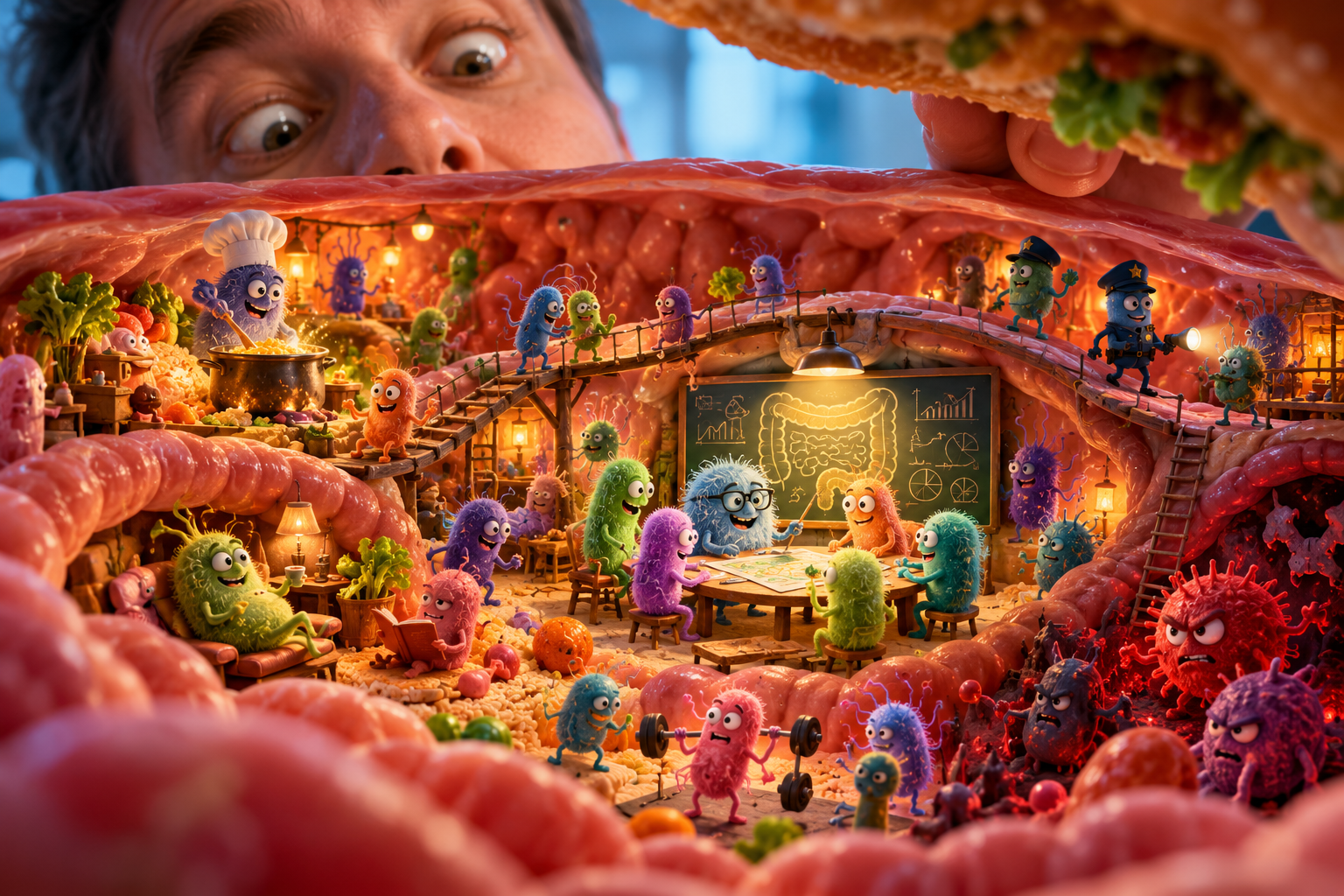
Microbiome – Billions of Strangers Who Live With Us and Meddle in Everything
Humans are peculiar creatures. We can argue with a neighbor over a poorly parked car, yet we let billions of foreign organisms live with us without a rental agreement.
Everyone feels like their body belongs exclusively to them.
That is, of course, a mistake. A cardinal one, in fact.
Inside our body and on its surface lives a massive population of roommates. When we go to work in the morning, they come along. They join us at the gym, the theater, visit the dentist with us, and walk down the wedding aisle. They share our bed, our grief, and our joys.
And even though we didn't pick them, don't know their names, and have never seen them with our own eyes, they influence our lives without exaggeration.
There are billions of them. In this specific coexistence, we share our body with bacteria, viruses, fungi, and other microorganisms.
Together, they form the microbiome – an extraordinarily complex ecosystem whose cornerstone is our digestive tract. It even has its own unique neural network: the enteric nervous system. It contains hundreds of millions of nerve cells, which is why it is often nicknamed the "second brain."
Don't imagine it as a small grey mass sitting next to the colon worrying about mortgage payments.
It's more like a friend on speed dial.
The brain and the digestive tract are in continuous, nonstop communication. Not only via the well-known vagus nerve – nervus vagus – but also through hormones, the immune system, and metabolites produced by gut microorganisms.
And what an intensely busy two-way hotline it is! They tell each other everything. Without exception.
The brain directly influences the gut this way. And what happens in the gut provides immediate feedback to the brain.
That is why we don't feel certain emotions just "in our head." We get butterflies in the stomach. Fear ties our gut in knots. And before an important meeting, we might lose our appetite entirely.
It all makes complete sense from the perspective of evolution.
For our ancient ancestors, it was vital for the brain to know what was happening in the gut, and for the gut to receive prompt instructions from headquarters.
Is it time to digest? Do we have enough energy? Is there imminent danger? Should we continue lunch, or run from a saber-toothed tiger?
In short, while you think you're just having a quiet lunch, a board meeting is taking place inside you that you never received an invite for.
The agendas of these meetings resemble a thriller, a detective story, and a drama all at once.
As in any great civilization, the vast majority are regular, law-abiding citizens just doing their job. Microorganisms cooperate, compete for food and space, and manufacture a variety of compounds.
Some help break down nutrients, others produce vital compounds for the gut environment, or communicate with the immune system.
Yet there is no shortage of villains and heroes. As long as a healthy balance exists among them, the civilization thrives peacefully.
Trouble can arise when this balance is disrupted and certain microorganisms gain an excessive upper hand over others. Such a breach of house rules is what we call dysbiosis.
It is influenced by a wide array of factors – genetics, age, environment, immune health, hormones, medications, stress, and lifestyle. And also by the one thing we directly control: our food.
So the next time you stand in front of an open refrigerator, remember that you're not choosing just for yourself. But for billions of roommates.
Be kind to them. After all, you can't evict them.
Sources: